



Our highlights
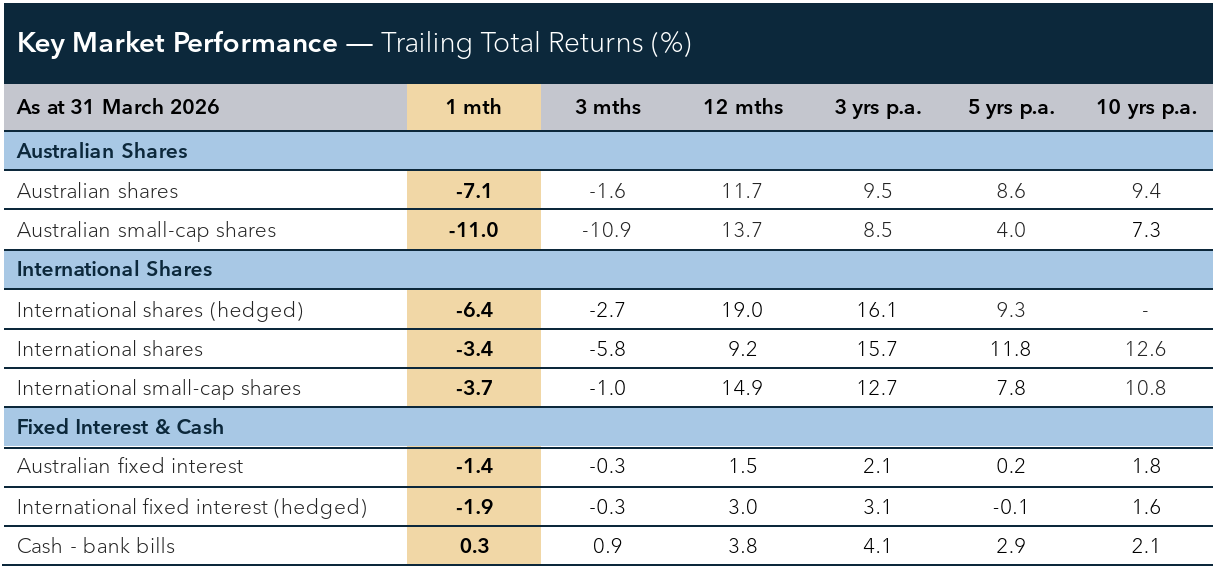
Global markets declined sharply in March as the Middle East conflict escalated, triggering a broad risk-off environment. Coordinated US-Israeli strikes on Iranian targets, which began in late February, raised concerns around energy supply and regional stability, pushing oil prices higher and leading to a global sell-off in shares and a repricing in bond markets. Market volatility increased as investors shifted focus from growth and earnings toward geopolitical risk and inflation pressures.
Australian shares fell significantly over the month, with broad-based weakness across most sectors. Materials declined as bulk commodity prices softened, while information technology and real estate were pressured by higher interest rate expectations and ongoing global weakness in growth sectors. In contrast, energy surged on higher oil prices and utilities also rose, supported by their links to energy markets and more defensive earnings profile.
International shares declined across most major regions amid heightened geopolitical tensions and rising energy prices. Europe and Asia were more heavily impacted, reflecting their greater exposure to higher energy costs, while the US proved relatively more resilient. Emerging markets also declined, reflecting higher oil prices, a stronger US dollar and more cautious investor sentiment. For Australian investors, the stronger US dollar helped cushion unhedged global share returns.
Australian and global fixed interest markets declined, although they continued to provide relative support compared to shares during a period of market stress. Government bonds fell as higher oil prices added to inflation concerns, pushing yields higher and weighing on prices. Credit markets weakened as spreads widened, meaning investors demanded greater return to hold corporate bonds over government bonds, particularly in lower quality segments.
Market observations and outlook
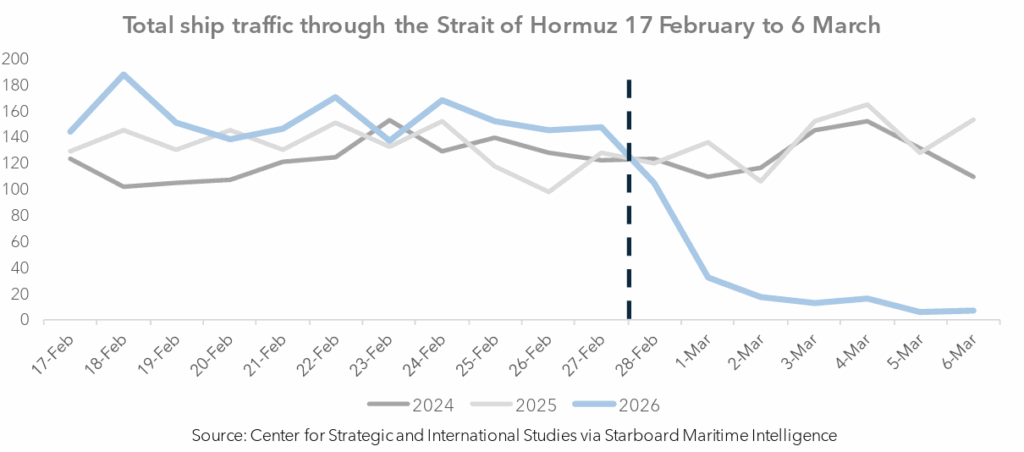
After a positive start to the year, sentiment shifted in March as confidence weakened amid escalating conflict in the Middle East, disrupting shipping flows through the Strait of Hormuz (see chart below), raising concerns around oil supply, lifting oil prices and the inflation outlook, with markets becoming more volatile as uncertainty increased.
Australia’s reliance on imported fuels, sourced largely from Asian refineries dependent on Middle Eastern crude, amplified the impact. Disruptions to fertiliser supply chains, where a meaningful share of imports is sourced via the Persian Gulf, added further pressure, lifting input costs across the broader economy. Together, these factors drove higher energy and production costs, weighing on more cyclically exposed sectors, while real assets such as infrastructure continued to demonstrate relative resilience.
Looking ahead, the investment landscape has become more complex, with a more cautious stance emerging as the earlier expectation of gradually falling inflation and near-term interest rate cuts is being challenged. The re-emergence of energy-driven inflation, combined with geopolitical uncertainty and structurally higher government debt, points to a more conditional path for central banks. Inflation risks remain material, valuations in parts of equity markets are elevated, and credit spreads remain tight relative to history despite widening more recently, supporting a more balanced and selective approach.
In this environment, selectivity is important, with a focus on managers and strategies exposed to companies with attractive valuations, broadening earnings and lower sensitivity to higher energy costs. Infrastructure, where revenues are often linked to inflation and supported by stable, long-term cash flows, offers more stability in an uncertain environment. Within fixed interest, higher quality exposures and domestic duration continue to offer stability in more volatile conditions, while credit warrants a more selective approach.
Despite heightened market volatility, the foundations for long-term growth remain firmly in place. Investment in AI continues to support productivity and earnings, while periods of volatility are opening up opportunities across regions and sectors. Maintaining a disciplined, diversified approach focused on quality and resilience remains central, with portfolio decisions grounded in long-term fundamentals and implemented with patience as conditions evolve.