



Monthly highlights
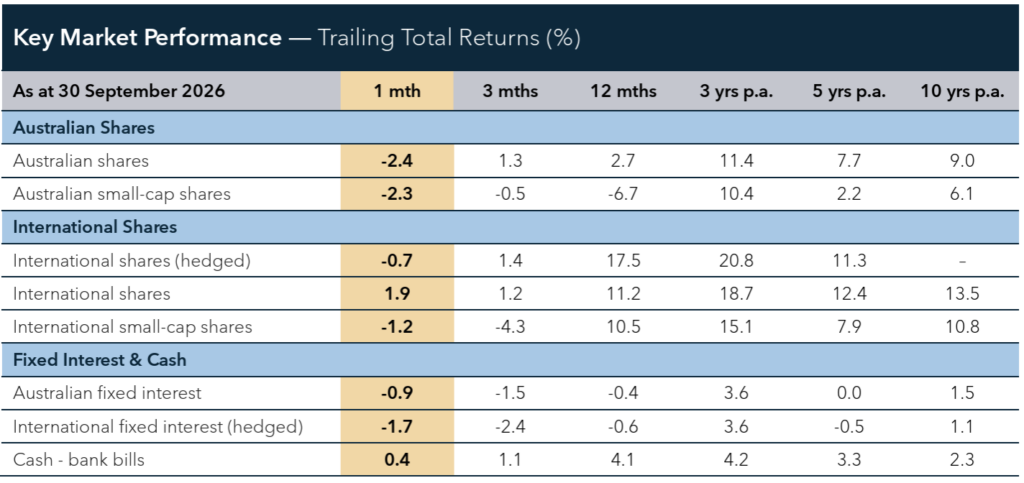
Global markets weakened in September as higher interest rates and bond yields created a more challenging backdrop for investors. The US Federal Reserve and Reserve Bank of Australia both raised interest rates as inflation remained elevated, while renewed Middle East tensions pushed oil prices higher. US technology remained resilient, while a weaker Australian dollar supported overseas returns.
Australian shares declined as higher interest rates weighed on several parts of the market. Technology companies were among the weakest as rising bond yields reduced the appeal of highergrowth investments, while materials fell alongside lower iron ore prices. Financials and consumer discretionary companies also declined as higher borrowing costs added pressure on households and businesses. Healthcare was a notable bright spot, supported by better-than-expected company results, while energy held up relatively well as oil prices rose.
International shares eased, although a weaker Australian dollar helped Australian investors. The US held up better than most major developed markets, supported by continued strength in AI-related technology companies, while Europe, the UK and Japan were weaker. Emerging markets also softened, although technology-focused markets such as Taiwan and South Korea performed better. For Australian investors, the weaker dollar boosted returns from unhedged overseas investments.
Australian and global fixed interest markets declined as government bond yields rose following further interest rate increases and ongoing inflation concerns. Rising yields weighed on bond prices as investors adjusted to the prospect of interest rates remaining higher for longer. Australian corporate bonds held up better than global corporate bonds as yields rose.
Market Observations and Outlook
The global economic expansion remains intact, supported by healthy manufacturing and services activity. Importantly, this cycle is being driven less by traditional consumer spending and more by business investment and powerful structural themes. Artificial intelligence, infrastructure, defence, energy security and more resilient supply chains are attracting significant capital, helping support economic growth as household spending moderates.
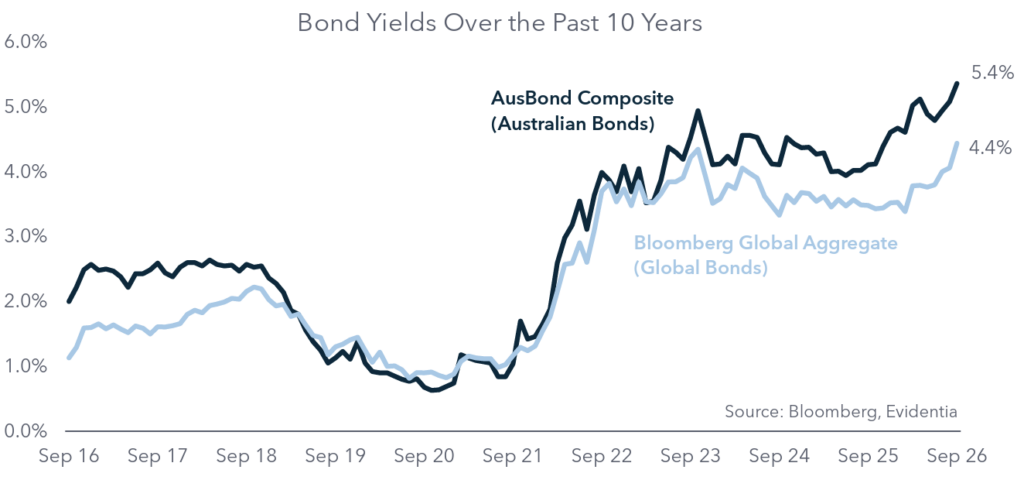
At the same time, government bond yields have risen sharply as large fiscal deficits, increased government borrowing and persistent inflation keep interest rates higher. Rather than causing a broad economic slowdown so far, higher borrowing costs are increasingly separating stronger businesses from more vulnerable ones. Large US technology companies remain well placed, with strong cash flows supporting continued investment in AI, while more highly indebted and lower-margin businesses face greater pressure from rising debt costs.
The consumer is also increasingly two-speed. Cost-ofliving pressures and fading pandemic-era savings are causing more indebted households to reduce discretionary spending. Meanwhile, wealthier and less indebted households continue to spend, helping overall consumption remain resilient despite growing pressure beneath the surface.
Australia faces a more challenging backdrop. Higher interest rates and cost-of-living pressures are weighing more heavily on households, while earnings growth outside resources and parts of the banking sector remains subdued. Unlike the US, the Australian share market has less exposure to the technology and structural growth themes helping offset the impact of higher interest rates globally, increasing the importance of careful company selection.
Looking ahead, continued economic growth and structural investment provide reasons for optimism, but higher bond yields, uneven consumer conditions and demanding valuations leave less room for disappointment. This environment favours diversification, earnings quality and valuation discipline, while higher bond yields offer improved income and potential portfolio protection if economic growth slows.