





What has happened in markets?
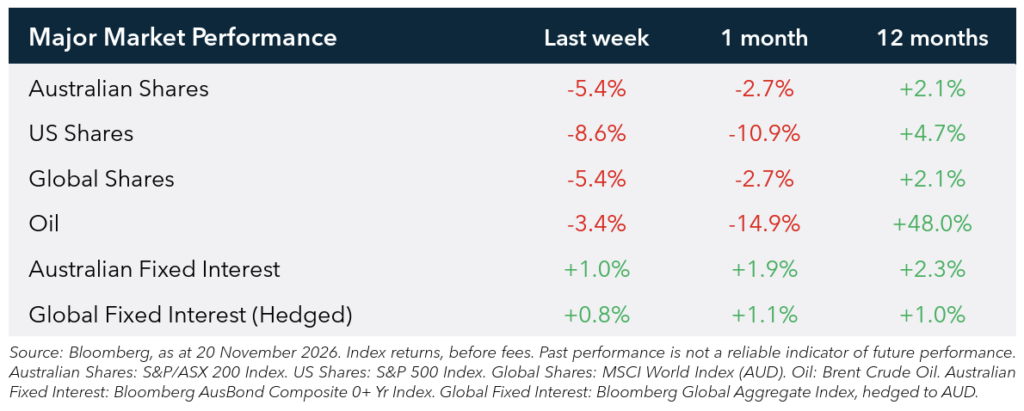
Global share markets experienced a sharp and widespread sell-off last week, with substantial declines across the US, Australia and other major markets. Technology companies were particularly hard hit, but the weakness extended well beyond the largest technology names. Government bonds performed strongly as investors sought more defensive investments.
Although these movements have understandably unsettled investors, periods of significant volatility are a normal feature of share markets. It is also important to consider recent declines in the context of longer-term performance, with major global share markets remaining higher over the past 12 months despite the sell-off. Importantly, the recent weakness appears to have been driven largely by changing investor sentiment rather than a fundamental deterioration in the global economic outlook.
What is driving the recent volatility?
The recent weakness reflects investors demanding a higher potential return to compensate for the risks of holding shares. Concerns about substantial investment in artificial intelligence (AI), and whether this spending will generate sufficient future profits, have contributed to the sell-off. However, selling has extended well beyond technology companies, with some investors reducing their exposure to shares as markets declined, adding to the downward pressure. This suggests a broader shift in sentiment rather than a significant deterioration in underlying economic conditions or corporate earnings.
The economic backdrop remains relatively supportive, particularly in the US, where consumer spending has been resilient and corporate earnings have generally continued to grow solidly. While investors have become more cautious about future returns, the underlying economic outlook has changed relatively little.
The sharp decline in oil prices also offers some encouragement. Although partly reflecting concerns about weaker global demand, lower energy costs can help ease inflation pressures, reduce costs for households and businesses, and lessen the need for further interest rate increases. If sustained, this could provide a more supportive environment for economic growth and financial markets. I
In Australia, higher interest rates are increasingly weighing on households and businesses, with the unemployment rate increasing to 4.9% in October 2026. While this points to a slowing economy, weaker growth will help ease inflation pressures over time and reduce the need for further interest rate increases. Indeed, this is precisely how tighter monetary policy (higher interest rates) works through the real economy to bring inflation back to target. This changing outlook has been particularly supportive of Australian government bonds, with falling yields pushing bond prices higher and contributing to positive investment returns.
Why is diversification important?
One encouraging feature of the recent volatility has been the strong performance of government bonds, particularly in Australia. As share markets declined, demand for more defensive investments increased, pushing bond yields lower and bond prices higher. Both Australian and international fixed interest delivered positive returns, helping to offset some of the weakness in share markets.
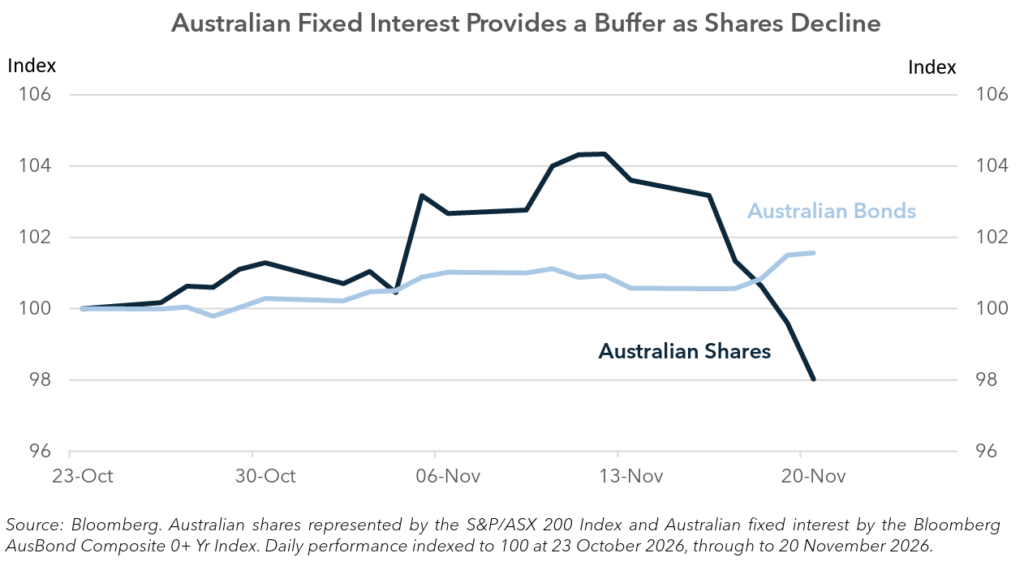
This provides a timely reminder of the benefits of diversification. Different investments respond differently to changing market conditions, and holding a combination of growth and defensive assets can help cushion the impact of sharp movements in any one market.
What does this mean for you?
While last week’s market declines were substantial, corrections are a normal part of investing. Share markets rarely move upwards in a straight line, and periods of uncertainty can produce sharp movements even when the longer-term economic outlook remains relatively sound.
Although further volatility is possible, the recent sell-off does not appear to reflect a fundamental deterioration in the global economy. Meanwhile, the positive contribution from government bonds highlights the importance of maintaining a diversified portfolio.
Our message is to remain focused on your long-term investment objectives rather than reacting to short-term market movements. While volatility can be uncomfortable, maintaining a diversified portfolio and a disciplined investment approach remains important to achieving your long-term financial goals.